

Can a single, well-structured prompt truly unlock photorealistic adult images without the usual artifacts?
You don’t need guesswork to get better results. In 2026, platforms like Aitubo AI and Stable Diffusion give you different levels of control over image generation. Choosing the right platform and model matters more than repeating vague queries.
92% of Sudowrite users finish manuscripts faster by using purpose-built tools, and the Muse model shows how mature fiction can avoid blocks. The same logic applies to nsfw image work: balance descriptive language with technical parameters to guide models, avoid distorted anatomy, and keep mood and story consistent for every character.
Focus on one clear scene and use concise technical cues. That single structured prompt can be the magic feature that saves time and improves your results.
Key Takeaways
- Pick the right platform — models affect control and final images.
- Use one clear, structured prompt to reduce common artifacts.
- Balance descriptive language with technical parameters for better results.
- Ground every character in a short story to keep mood consistent.
- Purpose-built tools speed up your process and improve output quality.
Understanding the Mechanics of NSFW AI Generation
Generation begins when the model interprets your words and maps them into a visual latent space. This is the core process that turns short text into a full image.
Platforms like Stable Diffusion, Aitubo AI, and Perchance act as different generators. Each uses unique training data and controls. That variance affects how an adult scene or woman is rendered.
In 2025 you can find 20+ free nsfw prompts that help you learn how wording changes output. Treat each run as an experiment: change one detail at a time to see how style, lighting, or character pose shifts.
The generator maps words to patterns from millions of images. Your control is limited by those patterns, so choosing the right tools and prompt generator matters for consistent character and mood.
- Analyze examples: compare images and their prompts to learn cause and effect.
- Iterate quickly: small edits teach you the model’s behavior.
- Mix technical cues with story: that one feature often creates the desired magic.
Essential NSFW Prompt Writing Tips for Better Results
When you replace vague praise with exact details, the model gives you cleaner results.
The Importance of Specificity
Specific words prevent common generation errors. Vague descriptors like “sexy” often yield bland or distorted images. Describe exact pose, hand placement, and facial expression instead.
Use concrete body cues to avoid freakish artifacts. Dora learned this the hard way when a run produced six fingers and melted candles in the background. Clear counts and positions stop those horror-film mistakes.
Using Descriptive Language
Think like a photographer. Note setting, lighting, and the character’s energy. “Soft golden light on a seated woman, relaxed shoulders, slight smile” guides the model better than empty praise.
For creative warm-ups, try a free use prompt generator like Perchance to spark ideas. Experiment with different tools and models to see how style and mood change your image output.
| Input (Vague) | Input (Specific) | Expected Effect | When to Use |
|---|---|---|---|
| “Sexy woman” | “Woman seated, soft golden light, relaxed pose” | Cleaner anatomy, clear mood | Base prompt for mood and pose |
| “Beautiful hands” | “Right hand on knee, five fingers visible, natural nails” | Fixes extra fingers, improves body detail | Anatomy fixes |
| “Amazing scene” | “Dimly lit room, candle glow, warm color grade” | Consistent lighting and atmosphere | Setting and mood control |
Structuring Your Prompts for Maximum Impact
Lead with the character and the pose so the model locks on the main idea first. Front-loading those core descriptors tells the generator what to prioritize during image generation.
Use a five-layer structure: subject, pose, setting, style, then technical quality modifiers. This order keeps the scene coherent and reduces guesswork.
Be specific about the woman or girl in your scene. Add age-appropriate features, clear hand placement, and a concise mood line. Specifics cut down on anatomy errors and generic art.
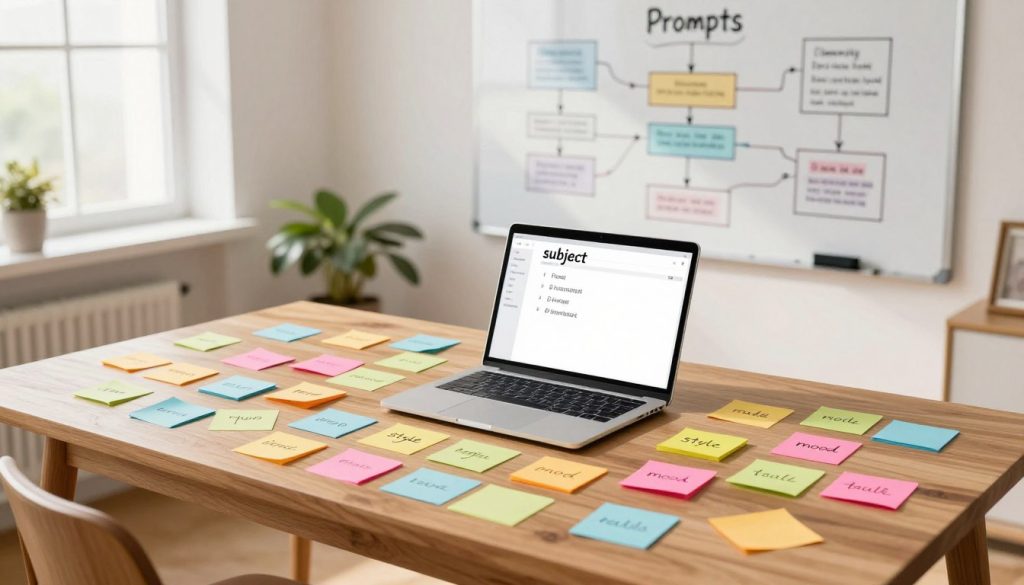
Keep prompts concise but descriptive. Name the lens, lighting, and color grade only when they matter. Every extra feature should support the story you want the image to tell.
- Front-load the most important words.
- Follow the five-layer order for consistent results.
- Test the same prompt across tools to see how each generator handles your phrasing.
Iterate and refine. With each pass you improve control over composition, lighting, and character consistency. That steady work is the real magic behind better images and cleaner content.
Mastering Anatomy and Pose Control
Nailing anatomy and pose control starts with clear, concise direction that the model can follow. You must treat the body like the main subject and give the generator a precise blueprint.
Handling Complex Body Positions
Describe joints, finger count, and weight distribution. Be explicit: “left hand on hip, five fingers visible, elbow bent.” That reduces extra limbs and fused fingers.
Use reference images or known style tags to improve pose control. Negative prompts also matter — list common artifacts to exclude.
Achieving Realistic Skin Textures
Set generation to SDXL’s native 1024×1024 when you need fine skin detail. Add quality modifiers like “high detail, microtexture, pore definition” to raise image fidelity.
Focus on how light hits curves and planes; small texture cues lift the overall art quality.
Managing Lighting and Atmosphere
Choose a clear setting: “warm window light, soft shadows, warm color grade.” Lighting anchors mood and makes the character feel real.
- Be specific to avoid horror-film artifacts.
- Combine positive details with targeted negative prompts.
- Practice across tools and models to save time and improve control.
Selecting the Right Tools for Your Creative Vision
Choosing the right image generator changes how your scene looks and how much control you get. Match your goals to a platform before you start building prompts or iterating outputs.
If you need photorealism, pick models tuned for high-fidelity images; for stylized art, use generators with anime or painterly presets.
Consider whether you want free use or paid, pro features. Free platforms help you learn; advanced tools give more control over lighting, anatomy, and final quality.
- Skill fit: Choose a tool that matches your technical comfort level.
- Community: Active users share models, nsfw prompts, and settings that speed learning.
- Legal and privacy checks: Read terms of service to keep your work compliant and private.
Test several platforms, compare images, and pick the one that streamlines your workflow. The best tool makes generating adult content feel efficient and creative.
Avoiding Common Pitfalls in Prompt Engineering
Good prompts act like blueprints; vague words are flimsy sketches.
Your instructions must be concrete. Vague adjectives like “beautiful” or “stunning” give the model no visual data. That often produces blurred faces, odd limbs, or inconsistent lighting.
Why Vague Adjectives Fail
Empty descriptors are empty calories for a generator. They do not tell the tool what to draw, so the output drifts toward the model’s default patterns.
Don’t write what you don’t want in the main text. Saying “no extra fingers” in the positive prompt can backfire. Use explicit negative lists instead.
- Keep prompts concise so the model focuses on the scene and character.
- Use a prompt generator that matches your model’s syntax to avoid format errors.
- Check resolution and setting to prevent common glitches like fused heads.

| Common Mistake | What Happens | How to Fix |
|---|---|---|
| Vague adjectives | Blurry faces, generic images | Describe pose, light, and expression |
| Overloaded quality tags | Confused model, lower quality | Limit tags; pick essential modifiers |
| Wrong resolution | Anatomy glitches, artifacts | Match generation size to desired image detail |
Leveraging Negative Prompts to Refine Output
Negative prompts act like guardrails for your generation. When you list items to exclude, the model avoids the most common defects. That saves you runs and post-processing time.
Be explicit. Add phrases such as “deformed hands,” “extra limbs,” “blurry,” or “fused fingers” to guide the generator away from those errors. For Pony Diffusion V6, include score tags so the model ranks quality higher.
Keep a reusable library of negative prompts tailored to each model. SDXL and Flux-based forks respond differently, so adapt your blacklist for the tools you use.
Use negatives as a safety net, not a fix-all. They let you concentrate the positive prompt on creative details of the character, scene, and mood. Many users find that a good negative list turns marginal runs into usable images.
| Problem | Negative Tag | When to Use |
|---|---|---|
| Extra fingers | “extra fingers, deformed hands” | All photoreal generations |
| Blurry faces | “blurry, low detail” | Low-res or noisy outputs |
| Wrong anatomy | “extra limbs, fused joints” | Complex poses and action scenes |
- Update negatives per model to raise the success rate of each image.
- Balance positive detail with focused exclusion to speed delivery of clean art.
Maintaining Character Consistency Across Generations
Build a compact set of style markers and append them to every job to lock in a character’s identity. Treat the character as a persistent entity. That simple habit saves you time and preserves look across scenes.
Building Style Anchors
Style anchors are repeatable cues you paste at the end of each prompt. Use exact lighting lines, camera lens, color grade, and signature wardrobe notes.
For Pony Diffusion V6 and Flux, keep the same style tags and a brief descriptive name for the character. Save those lines in a text file or a character card on a platform that supports persistent data.
Iterative Generation Techniques
Start runs with a lower CFG to explore variations, then raise it to lock in details. Check each image and reapply anchors if the model drifts.
“Consistency is the hallmark of a professional creator.”
| Technique | When to Use | Benefit |
|---|---|---|
| Style anchors | Every run | Stable appearance across images |
| Low CFG first | Early iterations | Safe exploration of variations |
| Character card | Long-term projects | Persistent metadata for models |
- Keep a curated library of successful prompts and negatives for each model.
- Verify anchors with every new scene to maintain visual integrity.
Conclusion
Practice, test, and refine your process to get steadily better results.
You will improve your nsfw content when you treat each run as a learning step. Focus on clear goals, pick platforms that allow adult work, and manage quality with concise technical cues.
Make prompt craft part of the routine. Use negatives, save style anchors, and iterate beat by beat rather than chasing a perfect single pass.
Final note: keep your characters consistent and respect platform rules. Apply these methods, and your content will look cleaner, more expressive, and more reliable.
FAQ
What should you include to improve deepfake porn results?
Focus on clear objectives: identify the subject, desired scene, mood, and level of realism. Use precise descriptors for facial features, body pose, lighting, and camera angle. Mention the intended platform or output size so tools render details correctly. Keep prompts concise but specific to guide the model toward your vision.
How does the generation process typically work?
Most systems start by interpreting your input to build a latent representation, then decode that into images or video frames. You’ll commonly control style, fidelity, and motion through parameters and repeated passes. Knowing whether the model uses image-to-image, text-to-image, or face-swapping helps you choose the right workflow.
How detailed should your descriptors be?
Be as specific as needed without overloading the request. Include age-appropriate descriptions, ethnicity, hair color, and facial landmarks. Describe clothing, props, and environment. For motion, outline key frames or gestures. Specificity reduces ambiguity and improves the odds of accurate results.
What role does descriptive language play in generating believable scenes?
Descriptive language sets tone and texture. Use sensory words for skin, hair, fabric, and ambient sounds. Indicate whether you want natural imperfections or a polished look. This helps models choose textures and postures that match your creative intent and makes outputs feel more authentic.
How should you structure inputs to get maximum impact?
Break the input into clear parts: subject, action, environment, camera specs, and style reference. List constraints or must-have elements first, then optional details. Use short, separate sentences or clauses to keep the model’s attention focused on each requirement.
How can you control complex poses and anatomy?
Provide joint-level direction when needed: torso tilt, limb angles, head orientation. Reference standard poses or photographic techniques. If available, supply reference images or 3D pose data to anchor the generation and avoid unnatural proportions.
What helps achieve convincing skin texture and tones?
Specify skin texture, pore detail, sheen, and subsurface scattering cues. Mention lighting type (soft, hard, rim) and color temperature to influence tone. If you need studio-grade realism, request high-resolution detail and natural blemishes to prevent an uncanny appearance.
How do lighting and atmosphere affect final output?
Lighting defines mood, depth, and perceived realism. State the light sources, direction, and intensity. Add atmospheric elements like haze, reflections, or lens artifacts to increase realism. Consistent lighting across frames is essential for believable motion sequences.
Which tools are best for mature image and video generation?
Choose platforms and software that match your technical needs: high-fidelity image synthesis, frame interpolation, and face-matching accuracy. Evaluate options like Stable Diffusion forks, commercial video face-swap suites, and neural rendering tools for workflow compatibility, quality, and speed.
What common mistakes should you avoid when engineering inputs?
Don’t use overly vague adjectives or conflicting instructions. Avoid long, run-on descriptions that confuse the model. Under-specifying camera or subject details leads to inconsistent results. Test iteratively and refine based on outputs rather than guessing all details upfront.
Why do vague adjectives fail to produce reliable results?
Vague words like “nice” or “beautiful” are subjective and leave too much room for interpretation. Models need concrete anchors—measurements, references, and precise sensory cues—to reproduce consistent visuals. Replace subjective terms with verifiable descriptors.
How can you use exclusionary inputs to refine outputs?
Employ negative lists to block unwanted elements: artifacts, mismatched limbs, or specific styles. Tell the model what to avoid as clearly as what to include. This reduces iterative cleanup and helps steer generation toward cleaner results.
How do you maintain character consistency across multiple generations?
Create a character sheet with fixed details: facial proportions, trademarks, clothing, and behavioral cues. Use consistent style anchors—same references, seed images, or style descriptors—across sessions. Save and reuse settings to preserve continuity.
What are style anchors and how do they help?
Style anchors are repeatable references like one or two high-quality images, a named photographic style, or a short list of adjectives that define look and tone. They act as templates so the model applies the same visual rules every time, maintaining character and mood consistency.
What iterative techniques improve final results?
Use progressive refinement: start with a rough draft, note failures, then incrementally add constraints or references. Blend generations, perform frame-by-frame corrections, and combine manual retouching with automated passes. Each iteration should target a specific flaw rather than redoing everything.